August 4, 2026

How Barnegat Bay Master Naturalist Don Crawford is Aiding in Global Monarch Butterfly Tracking

by Nina Sassano

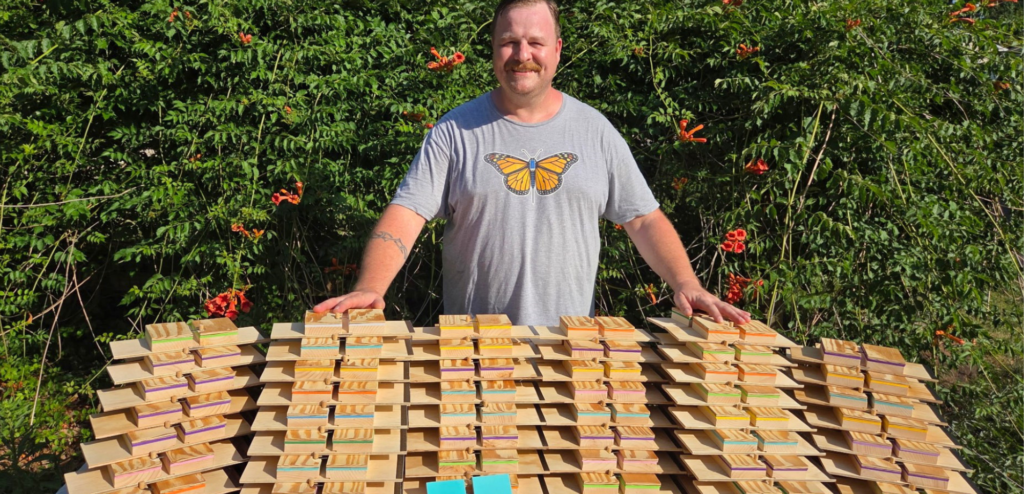
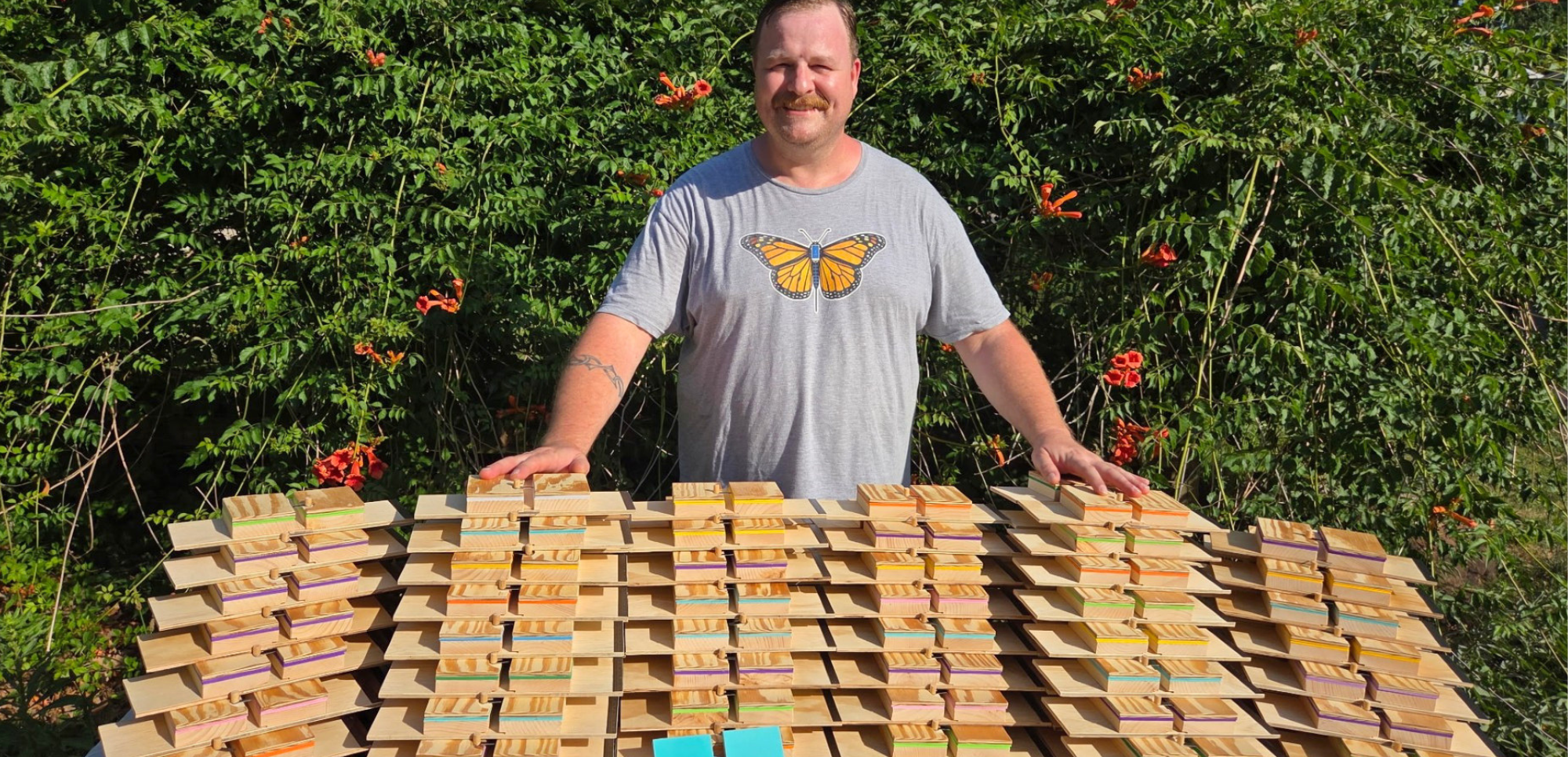
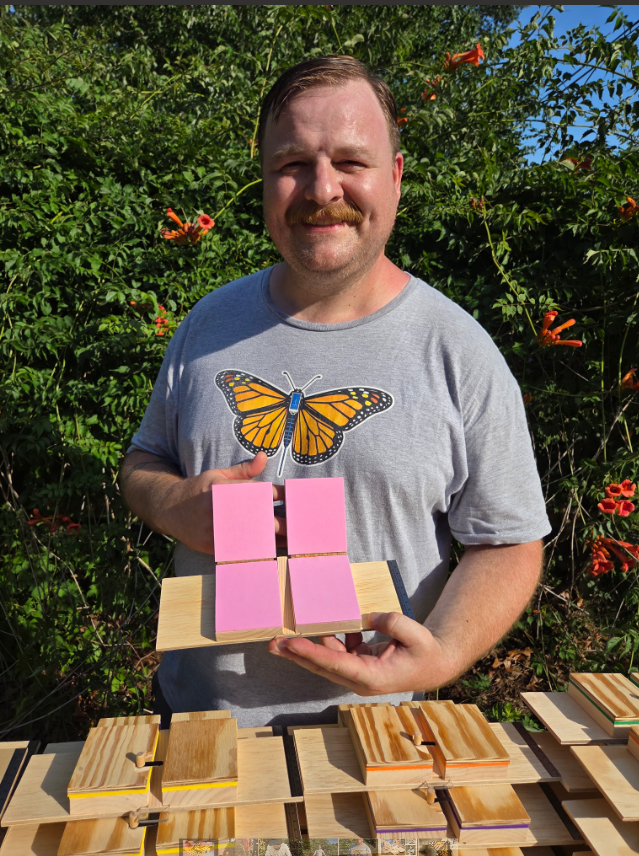
Don Crawford with his tagging devices

The following article was written by Barnegat Bay Volunteer Master Naturalist Don Crawford.

Monarch butterflies are easy to love and they really are remarkable creatures. Each year they migrate north from their overwintering grounds near Michoacán, Mexico, into the United States and Canada. Their annual journey spans around five generations before the strongest butterflies begin their journey back to the same mountain forests their great-great-great-grandparents flew to the year before.

Countless efforts have been made over the years to learn more about their migration routes. Press-on stickers have been used since the 1990s to gather migration data from individual butterflies, but the most modern innovation comes in the form of tiny solar transmitters that can be attached directly to monarchs, allowing scientists to accurately chart their journeys.
{6029ea9f a875 4614 a839 a01e086a5520}

These solar transmitters, named BlūMorpho tags, were created in 2023 in Cape May by Cellular Tracking Technologies, a wildlife telemetry company. They’re made up of a tiny solar panel, some circuitry, and an antenna that all weigh less than a grain of rice. The tags are glued onto the butterfly’s thorax and send out a signal every few seconds whenever they’re in the sun. At first, they could only be detected by individuals nearby running an app on their phones.

In 2025, CTT figured out how to make these tags detectable passively by phones, and that’s where I think electronic butterfly tracking really took a huge leap forward. Last year was the first time individual butterflies were being charted migrating from as far north as Canada all the way down to the sanctuaries in Mexico. Hundreds—even thousands—of data points could be collected from a single butterfly. It was an explosion of scientific data that anyone can follow through an app called Project Monarch.  I highly recommend trying it.

I began regularly attending public tagging events at the Cape May Point Arts and Science Center when they started in 2023 and have attended nearly all of them since. Through those events I got to meet and network with people who are deeply passionate about studying monarchs.

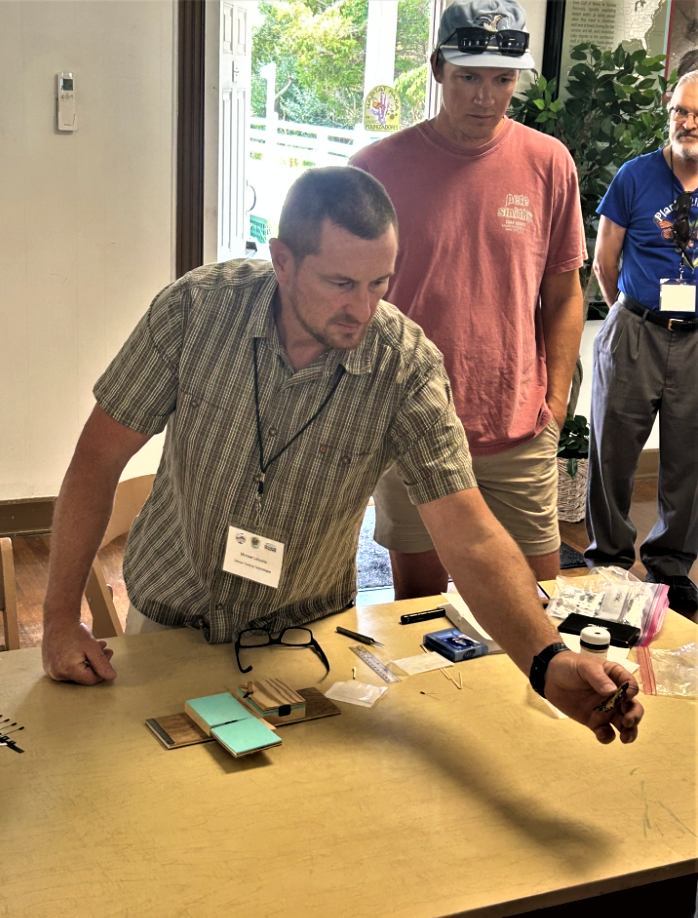
One of those people was Mark Garland, who was the primary demonstrator during the Cape May tagging sessions. In the beginning it took two people to apply a BlūMorpho tag—one person to hold the butterfly still and another to attach the transmitter. The technique worked, but Mark mentioned that he hoped someone would come up with a better way to hold them someday.

“This man needs a tool!” I thought.

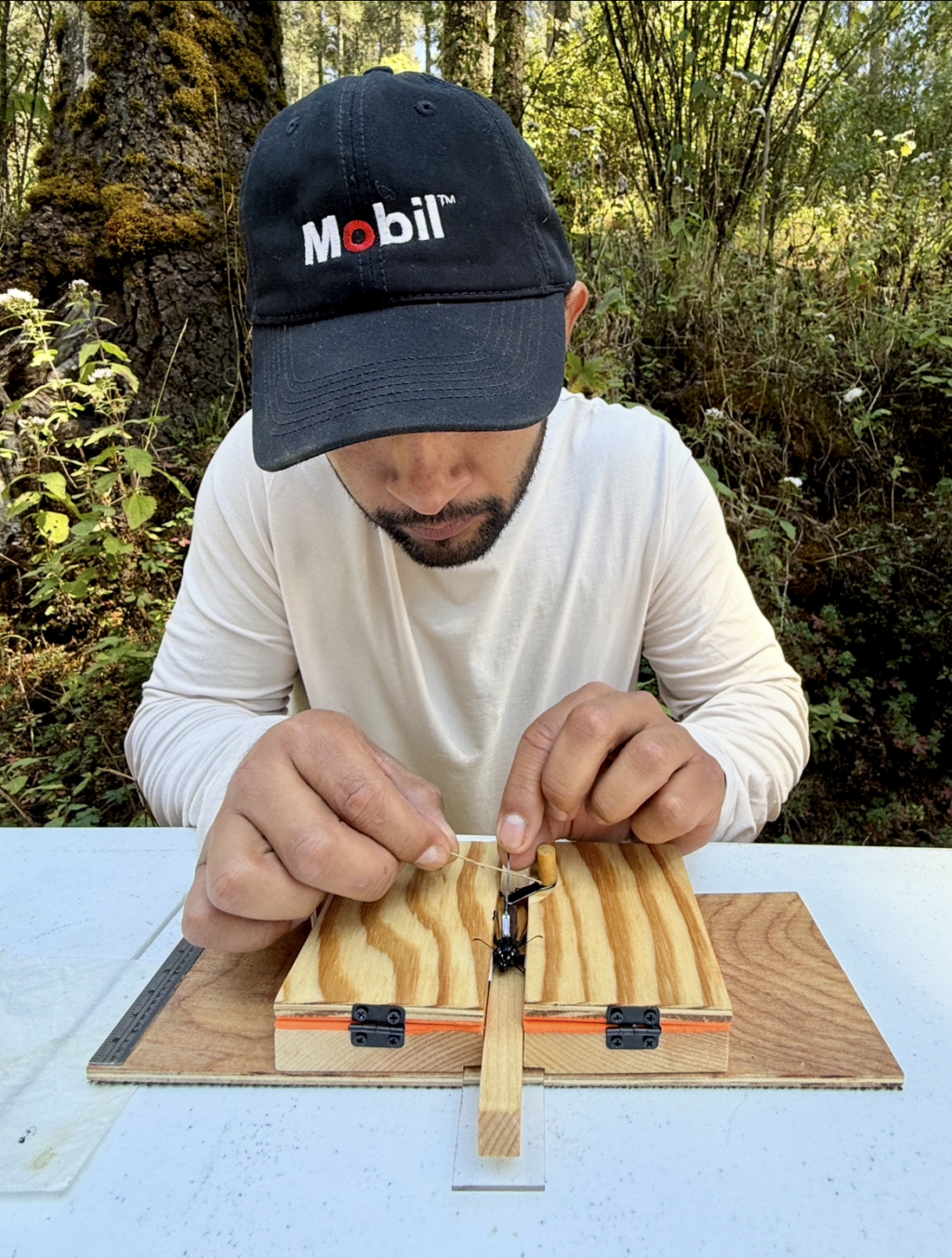
On the drive home I started working out an idea in my head. There needed to be a channel for the body and legs, hinged doors to hold the wings flat, and the upper thorax had to remain exposed so the tag could be attached. The very next day I built my first prototype out of some wood, a couple of hinges and some soft foam.

I brought it down to Cape May and showed it to Mark. He tried my prototype, then another technique using a butterfly spreading board, a few washers, and a pen. I thought the spreading board idea was clever, and while my prototype showed promise, it turned out to be a little too big and needed some revisions.

So I made another one.
cbf78717 1a79 49bd ade2 4a1be6b9e01e

The second version was more compact. It still had the slot down the middle and the two hinged doors to hold the wings flat, but I also added a sliding wedge to support the butterfly’s thorax from below. I put a wooden pin in one of the doors to keep the abdomen straight because monarchs like to curl it upward when they can’t move.

I brought that one back the next week.

This version worked much better. The wedge did exactly what I hoped it would, but the abdomen pin was only OK. To really be the best, we realized it would have to be adjustable.

So I went home, figured out a way to make the abdomen guard adjustable, built another version, and brought it back.

That did the trick.

Everyone who tried the board—or even just watched it being used—seemed to like it.

Then something happened that I never saw coming.

In February 2026, Cellular Tracking Technologies and the Cape May Arts and Science Center partnered with WWF, CONANP, and other conservation organizations in Mexico for the first radio-tagging experiment in history on monarch butterflies at their overwintering colonies in El Rosario and others.

They asked me if I could make more of those tagging boards for the trip.

I couldn’t believe it.
{86ce7f8c c48e 4172 a8d1 8749c978e2bd}

I hurried and built five more boards before they left for Mexico. A documentary called Monarch: Generation Treasures was filmed during that expedition and will be released online this month.

From there, word started getting around. I’ve received requests for more tagging boards from organizations and individuals using BlūMorpho tags in their own research. I got to participate in a four-day conference with scientists from all over North America, and my boards have appeared in news stories, webinars, and educational presentations.

I took the Barnegat Bay Volunteer Master Naturalist course about fourteen years ago and have been active in citizen science ever since. Through volunteering and networking with people, I’ve had the opportunity to participate in some very rewarding citizen science—both inside and outside the Barnegat Bay watershed.  Looking back,  I’m grateful for the opportunities that volunteering has given me.
Explore More Insights from Barnegat Bay

Dive deeper into the ongoing efforts to protect and restore our environment with more updates and initiatives that you can take part in. Check out our latest blog posts for valuable tips and insights.

UNKNOWN

There is limited data available to quantify Wetland and Riparian Buffer Preservation, or updated data to quantify Wetland Acreage. The BBP has obtained funding and will begin assessment efforts for both targets, in the next few years.


 Hard Clam abundance has not been updated since 2012. Recovery of the stock will be guided by the Fishery Management Plan for Hard Clams, which is under development with the NJDEP, BBP, and other organizations. Reclam the Bay and other partners have continued to plant clams for restoration purposes. Continued plantings in strategic locations which maximize survival and reproduction is one strategy to pursue in the coming years. This work can use a model developed by Rutgers with BBP funding which identified areas where planted clams could have the greatest dispersal of their larvae and thus potentially maximally contribute to the recovery of the stock.

 Water Withdrawals were over the target in the 2021 report; USGS has not yet completed its latest update, so a definitive determination of status is not available. However, additional NJDEP data show that it is likely that we continue to not meet the target. Per capita water use has gone down, demonstrating the effectiveness of water-saving appliances and practices, but that decrease has been offset by population gains. 


IN PROGRESS

New maps quantifying Submerged Aquatic Vegetation extent were developed, but poor image clarity resulted in a high degree of uncertainty in the total acreage. NJDEP and Rutgers are working to resolve the uncertainty of these maps, and improve the total acreage estimate. Funding has also been obtained for further research and restoration activities. Several groups are developing potential restoration actions.

The USGS has completed the first phase of its study to identify minimum ecological flows in select Barnegat Bay tributaries. USGS scientists compared streamflow statistics between historical and current time periods to better understand trends in watershed flow conditions. This work provides a foundation for developing ecological flow targets in the Barnegat Bay watershed.  Similar to SAV extent, funding (approximately $450K) has been obtained by the BBP to complete the remaining phases necessary for threshold determination.


TARGETS ACHIEVED

No targets can be considered “Achieved” at this time.


NOT ACHIEVING

Several Public Swimming Beaches exceeded their safe swimming standards more frequently than during their baseline time period (2016-2018).

While most beaches are routinely safe for swimming, several problematic areas such as Beachwood, Hancock, Windward, and several lake beaches need track-down studies and restoration to pinpoint and address sources of bacteria.

Acres of Approved Shellfish Waters decreased from the last report. While this decrease was small, it represents a loss of previously approved waters. Similar to public beaches, track-down studies and restoration work are needed to pinpoint and address sources of bacteria.


How Barnegat Bay Master Naturalist Don Crawford is Aiding in Global Monarch Butterfly Tracking

The following article was written by Barnegat Bay Volunteer Master Naturalist Don Crawford.

Monarch butterflies are easy to love and they really are remarkable creatures. Each year they migrate north from their overwintering grounds near Michoacán, Mexico, into the United States and Canada. Their annual journey spans around five generations before the strongest butterflies begin their journey back to the same mountain forests their great-great-great-grandparents flew to the year before.

Countless efforts have been made over the years to learn more about their migration routes. Press-on stickers have been used since the 1990s to gather migration data from individual butterflies, but the most modern innovation comes in the form of tiny solar transmitters that can be attached directly to monarchs, allowing scientists to accurately chart their journeys.

{6029ea9f a875 4614 a839 a01e086a5520}

These solar transmitters, named BlūMorpho tags, were created in 2023 in Cape May by Cellular Tracking Technologies, a wildlife telemetry company. They’re made up of a tiny solar panel, some circuitry, and an antenna that all weigh less than a grain of rice. The tags are glued onto the butterfly’s thorax and send out a signal every few seconds whenever they’re in the sun. At first, they could only be detected by individuals nearby running an app on their phones.

In 2025, CTT figured out how to make these tags detectable passively by phones, and that’s where I think electronic butterfly tracking really took a huge leap forward. Last year was the first time individual butterflies were being charted migrating from as far north as Canada all the way down to the sanctuaries in Mexico. Hundreds—even thousands—of data points could be collected from a single butterfly. It was an explosion of scientific data that anyone can follow through an app called Project Monarch.  I highly recommend trying it.

I began regularly attending public tagging events at the Cape May Point Arts and Science Center when they started in 2023 and have attended nearly all of them since. Through those events I got to meet and network with people who are deeply passionate about studying monarchs.

One of those people was Mark Garland, who was the primary demonstrator during the Cape May tagging sessions. In the beginning it took two people to apply a BlūMorpho tag—one person to hold the butterfly still and another to attach the transmitter. The technique worked, but Mark mentioned that he hoped someone would come up with a better way to hold them someday.

“This man needs a tool!” I thought.

On the drive home I started working out an idea in my head. There needed to be a channel for the body and legs, hinged doors to hold the wings flat, and the upper thorax had to remain exposed so the tag could be attached. The very next day I built my first prototype out of some wood, a couple of hinges and some soft foam.

I brought it down to Cape May and showed it to Mark. He tried my prototype, then another technique using a butterfly spreading board, a few washers, and a pen. I thought the spreading board idea was clever, and while my prototype showed promise, it turned out to be a little too big and needed some revisions.

So I made another one.

cbf78717 1a79 49bd ade2 4a1be6b9e01e

The second version was more compact. It still had the slot down the middle and the two hinged doors to hold the wings flat, but I also added a sliding wedge to support the butterfly’s thorax from below. I put a wooden pin in one of the doors to keep the abdomen straight because monarchs like to curl it upward when they can’t move.

I brought that one back the next week.

This version worked much better. The wedge did exactly what I hoped it would, but the abdomen pin was only OK. To really be the best, we realized it would have to be adjustable.

So I went home, figured out a way to make the abdomen guard adjustable, built another version, and brought it back.

That did the trick.

Everyone who tried the board—or even just watched it being used—seemed to like it.

Then something happened that I never saw coming.

In February 2026, Cellular Tracking Technologies and the Cape May Arts and Science Center partnered with WWF, CONANP, and other conservation organizations in Mexico for the first radio-tagging experiment in history on monarch butterflies at their overwintering colonies in El Rosario and others.

They asked me if I could make more of those tagging boards for the trip.

I couldn’t believe it.

{86ce7f8c c48e 4172 a8d1 8749c978e2bd}

I hurried and built five more boards before they left for Mexico. A documentary called Monarch: Generation Treasures was filmed during that expedition and will be released online this month.

From there, word started getting around. I’ve received requests for more tagging boards from organizations and individuals using BlūMorpho tags in their own research. I got to participate in a four-day conference with scientists from all over North America, and my boards have appeared in news stories, webinars, and educational presentations.

I took the Barnegat Bay Volunteer Master Naturalist course about fourteen years ago and have been active in citizen science ever since. Through volunteering and networking with people, I’ve had the opportunity to participate in some very rewarding citizen science—both inside and outside the Barnegat Bay watershed.  Looking back,  I’m grateful for the opportunities that volunteering has given me.
Contact How Barnegat Bay Master Naturalist Don Crawford is Aiding in Global Monarch Butterfly TrackingContact How Barnegat Bay Master Naturalist Don Crawford is Aiding in Global Monarch Butterfly Tracking
Don Crawford with his tagging devices