February 17, 2026

Master Naturalist Nancy Reamy’s Story on Becoming a Bay Advocate

by Nancy Reamy

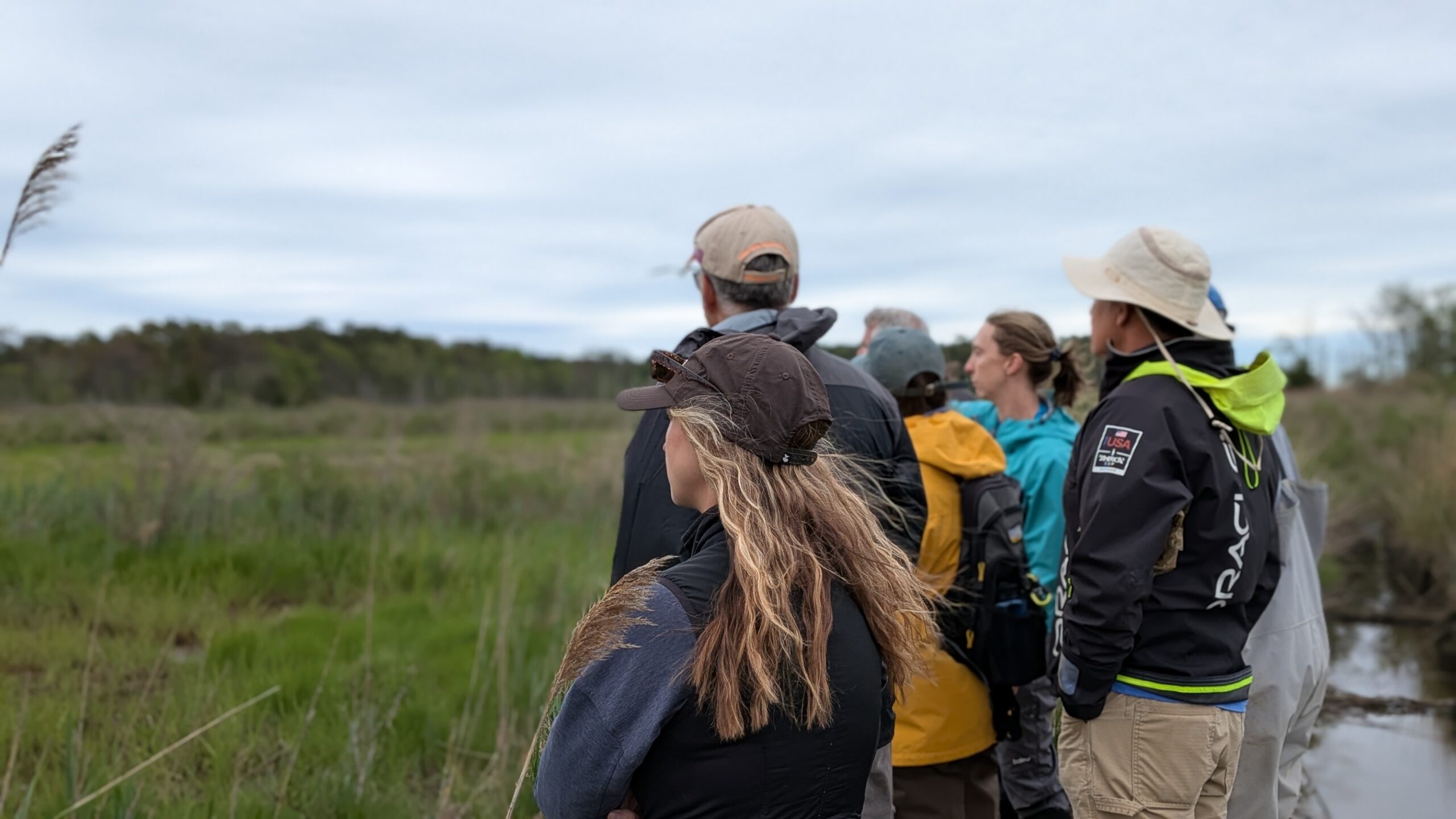
Nina and Paige R with the Barnegat Bay Volunteer Master Naturalists

Nancy Reamy, a graduate of the 2025 Barnegat Bay Volunteer Master Naturalist program, shares her story on becoming a Jersey-friendly citizen.

“I was just a Jersey girl. Doin’ all the (outdoor) Jersey things. I enjoyed the shore; I love swimming and kayaking, hiking, being in nature and gardening- all high on my list of fulfilling activities.

I grew up in a time of an environmental awakening. We were taught about the evils of pollution and the need to be stewards of the earth; the Clean Air Act and the observance of Earth Day became ‘things’ when I was coming up. Maybe during this time, I gleaned that chemicals (pesticides and fertilizers) were not great for humans and other living things and so I just never used them on my own lawn or flower beds (yay!) I’m somewhat inclined, however, to think that decision was mostly a happy accident. 

Though I thought I knew enough about being responsible on a personal level: “reduce, reuse, recycle…conserve energy…don’t waste food…hug a tree!” and I understood that every little bit counts, there was so much more to learn. Becoming educated about the bigger issues regarding our environment and fluctuating weather meant expanding my knowledge on many different levels: the personal, the political and the global; quite a daunting and seemingly neverending challenge.

pxl 20250516 145750163.portrait

One must of course, start somewhere, and for me my first classroom was my own backyard and my first teacher…my older sister, Brenda.   

Long before I heard of the Barnegat Bay Partnership’s Master Naturalist Program…years before I learned about fertilizer runoff into our waterways and prior to hearing about Jersey- Friendly Yards and the crucial role of pollinators for our planet …my sister, a self-taught gardener at the time living in south Florida, became obsessed with native plants and their importance. She made it her mission (seemingly overnight) to impart this knowledge to anyone who would give her the time of day.

Often her insistent harping on the subject was, if I’m being honest, eye-rollingly annoying. But she persevered and I credit her with shedding the first bit of (sun)light about this important topic to me, her now-willing student.  

By and by…my own small yard and garden in Ocean County has morphed into a healthy, chemical-free oasis that each season supports more and more native flowers, shrubs and trees that attract bigger numbers of birds, bees and butterflies while keeping toxins out of the toms river and Barnegat Bay watershed. (certified Jersey-Friendly!)

Now I too like to spread the word instead of fertilizer.

And I too have become obsessed with more Jersey- Friendly Yard ideas and resources and love to share some of what I’ve learned regarding ‘good practices’.

My latest quest again came about by another accident…this time an unhappy one. A few summers ago I was quite alarmed (read…apoplectic!) when one of the myriad ‘mosquito control’ companies rolled up to my neighbor’s property and basically ‘napalmed’ not only their yard (as instructed) but my pollinator garden too. Although my word choices may seem hyperbolic, the end result was pretty devastating. This ‘innocent error’ led to the basic extermination of every bee and butterfly in my little paradise that summer, and any bug that survived was of naturally going to be ingested by an unsuspecting bird or fish swimming nearby. It was a very sad summer and I was determined not to ever have a repeat performance. 

My determination led to research and that research led me to the discovery of an organic, biological mosquito control product. The active ingredient is bacillus thuringiensis.  This product is available at most hardware stores and garden centers; it’s easy to use once you get set up, inexpensive and pretty effective! There are some detractors to this product, but I submit that 1.) no one wants to be on a mosquito’s menu and 2.) I find this to be a gentler and more natural approach to making your yard more enjoyable for you and healthier for most living creatures! 

So, these days, my goal is to provide information and instruction on how others can set up and maintain residential ‘mosquito buckets’. 

I believe we all benefit from a healthier yard and once the garden season is in full swing, I hope we all get to sit comfortably in those aforementioned yards watching the wonder of nature as bees, butterflies, bats, ladybugs and birds do what they do best.”
Explore More Insights from Barnegat Bay

Dive deeper into the ongoing efforts to protect and restore our environment with more updates and initiatives that you can take part in. Check out our latest blog posts for valuable tips and insights.

UNKNOWN

There is limited data available to quantify Wetland and Riparian Buffer Preservation, or updated data to quantify Wetland Acreage. The BBP has obtained funding and will begin assessment efforts for both targets, in the next few years.


 Hard Clam abundance has not been updated since 2012. Recovery of the stock will be guided by the Fishery Management Plan for Hard Clams, which is under development with the NJDEP, BBP, and other organizations. Reclam the Bay and other partners have continued to plant clams for restoration purposes. Continued plantings in strategic locations which maximize survival and reproduction is one strategy to pursue in the coming years. This work can use a model developed by Rutgers with BBP funding which identified areas where planted clams could have the greatest dispersal of their larvae and thus potentially maximally contribute to the recovery of the stock.

 Water Withdrawals were over the target in the 2021 report; USGS has not yet completed its latest update, so a definitive determination of status is not available. However, additional NJDEP data show that it is likely that we continue to not meet the target. Per capita water use has gone down, demonstrating the effectiveness of water-saving appliances and practices, but that decrease has been offset by population gains. 


IN PROGRESS

New maps quantifying Submerged Aquatic Vegetation extent were developed, but poor image clarity resulted in a high degree of uncertainty in the total acreage. NJDEP and Rutgers are working to resolve the uncertainty of these maps, and improve the total acreage estimate. Funding has also been obtained for further research and restoration activities. Several groups are developing potential restoration actions.

The USGS has completed the first phase of its study to identify minimum ecological flows in select Barnegat Bay tributaries. USGS scientists compared streamflow statistics between historical and current time periods to better understand trends in watershed flow conditions. This work provides a foundation for developing ecological flow targets in the Barnegat Bay watershed.  Similar to SAV extent, funding (approximately $450K) has been obtained by the BBP to complete the remaining phases necessary for threshold determination.


TARGETS ACHIEVED

No targets can be considered “Achieved” at this time.


NOT ACHIEVING

Several Public Swimming Beaches exceeded their safe swimming standards more frequently than during their baseline time period (2016-2018).

While most beaches are routinely safe for swimming, several problematic areas such as Beachwood, Hancock, Windward, and several lake beaches need track-down studies and restoration to pinpoint and address sources of bacteria.

Acres of Approved Shellfish Waters decreased from the last report. While this decrease was small, it represents a loss of previously approved waters. Similar to public beaches, track-down studies and restoration work are needed to pinpoint and address sources of bacteria.


Master Naturalist Nancy Reamy’s Story on Becoming a Bay Advocate

Nancy Reamy, a graduate of the 2025 Barnegat Bay Volunteer Master Naturalist program, shares her story on becoming a Jersey-friendly citizen.

“I was just a Jersey girl. Doin’ all the (outdoor) Jersey things. I enjoyed the shore; I love swimming and kayaking, hiking, being in nature and gardening- all high on my list of fulfilling activities.

I grew up in a time of an environmental awakening. We were taught about the evils of pollution and the need to be stewards of the earth; the Clean Air Act and the observance of Earth Day became ‘things’ when I was coming up. Maybe during this time, I gleaned that chemicals (pesticides and fertilizers) were not great for humans and other living things and so I just never used them on my own lawn or flower beds (yay!) I’m somewhat inclined, however, to think that decision was mostly a happy accident. 

Though I thought I knew enough about being responsible on a personal level: “reduce, reuse, recycle…conserve energy…don’t waste food…hug a tree!” and I understood that every little bit counts, there was so much more to learn. Becoming educated about the bigger issues regarding our environment and fluctuating weather meant expanding my knowledge on many different levels: the personal, the political and the global; quite a daunting and seemingly neverending challenge.

pxl 20250516 145750163.portrait

One must of course, start somewhere, and for me my first classroom was my own backyard and my first teacher…my older sister, Brenda.   

Long before I heard of the Barnegat Bay Partnership’s Master Naturalist Program…years before I learned about fertilizer runoff into our waterways and prior to hearing about Jersey- Friendly Yards and the crucial role of pollinators for our planet …my sister, a self-taught gardener at the time living in south Florida, became obsessed with native plants and their importance. She made it her mission (seemingly overnight) to impart this knowledge to anyone who would give her the time of day.

Often her insistent harping on the subject was, if I’m being honest, eye-rollingly annoying. But she persevered and I credit her with shedding the first bit of (sun)light about this important topic to me, her now-willing student.  

By and by…my own small yard and garden in Ocean County has morphed into a healthy, chemical-free oasis that each season supports more and more native flowers, shrubs and trees that attract bigger numbers of birds, bees and butterflies while keeping toxins out of the toms river and Barnegat Bay watershed. (certified Jersey-Friendly!)

Now I too like to spread the word instead of fertilizer.

And I too have become obsessed with more Jersey- Friendly Yard ideas and resources and love to share some of what I’ve learned regarding ‘good practices’.

My latest quest again came about by another accident…this time an unhappy one. A few summers ago I was quite alarmed (read…apoplectic!) when one of the myriad ‘mosquito control’ companies rolled up to my neighbor’s property and basically ‘napalmed’ not only their yard (as instructed) but my pollinator garden too. Although my word choices may seem hyperbolic, the end result was pretty devastating. This ‘innocent error’ led to the basic extermination of every bee and butterfly in my little paradise that summer, and any bug that survived was of naturally going to be ingested by an unsuspecting bird or fish swimming nearby. It was a very sad summer and I was determined not to ever have a repeat performance. 

My determination led to research and that research led me to the discovery of an organic, biological mosquito control product. The active ingredient is bacillus thuringiensis.  This product is available at most hardware stores and garden centers; it’s easy to use once you get set up, inexpensive and pretty effective! There are some detractors to this product, but I submit that 1.) no one wants to be on a mosquito’s menu and 2.) I find this to be a gentler and more natural approach to making your yard more enjoyable for you and healthier for most living creatures! 

So, these days, my goal is to provide information and instruction on how others can set up and maintain residential ‘mosquito buckets’. 

I believe we all benefit from a healthier yard and once the garden season is in full swing, I hope we all get to sit comfortably in those aforementioned yards watching the wonder of nature as bees, butterflies, bats, ladybugs and birds do what they do best.”
Contact Master Naturalist Nancy Reamy’s Story on Becoming a Bay AdvocateContact Master Naturalist Nancy Reamy’s Story on Becoming a Bay Advocate
Nina and Paige R with the Barnegat Bay Volunteer Master Naturalists