September 8, 2026

Appreciating our Watershed’s Fungi: Guest Blog by Brianna Casario

by Nina Sassano

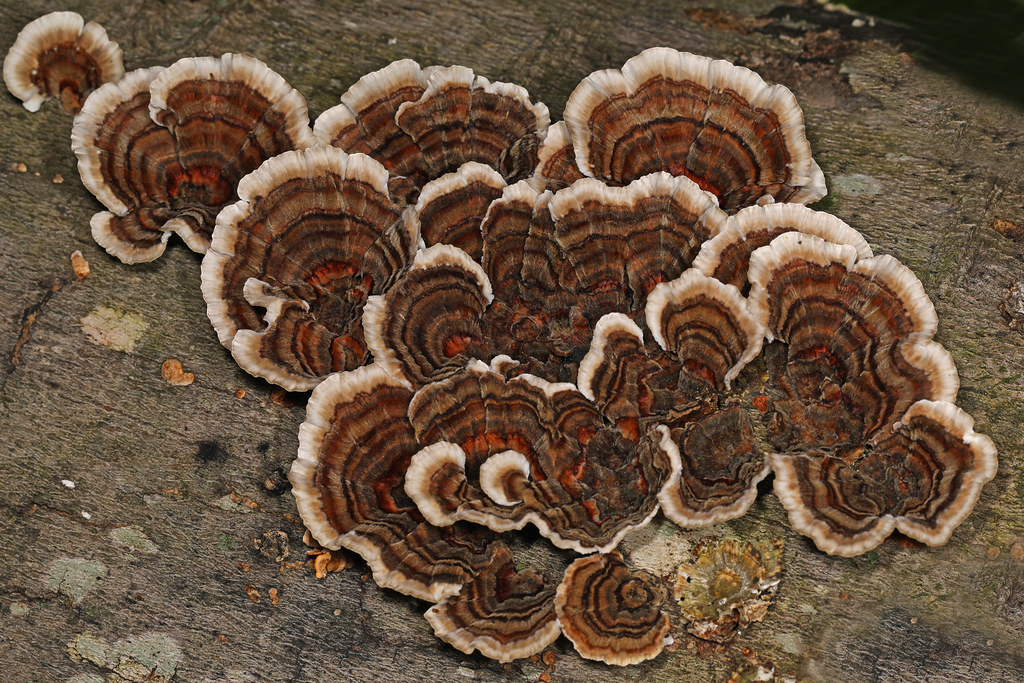
Trametes versicolor Turkey-Tail

This blog was written by BBP’s technician, and former NJ Watershed Ambassador, Brianna Casario.


The Fungi Kingdom can be easily overlooked when one is out exploring the natural world. Although mushrooms might not be thought to be as charismatic as plants or animals, fungi play a crucial role in the ecosystem and without them our intricately connected systems could collapse. The Barnegat Bay Watershed is home to many species of fascinating fungi. 

Here is an overview of some of the most interesting fungi (in my opinion) spotted in or near Ocean County. I found most of these recorded observations through a deep dive into the research grade observations on iNaturalist.

Entoloma indigoferum
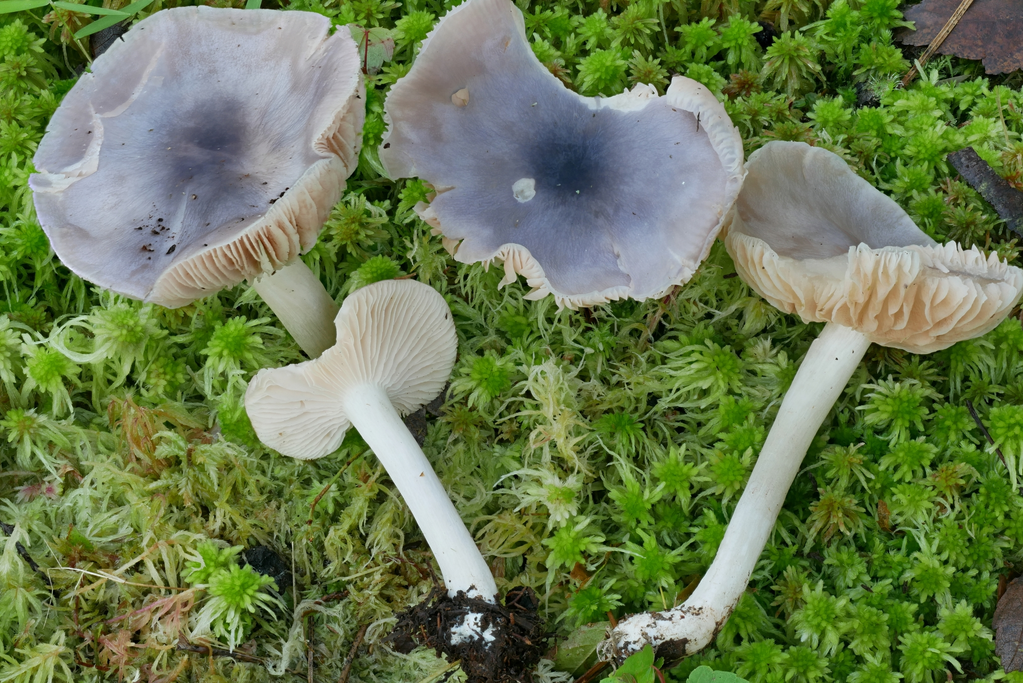
Entoloma indigoferum
Photo Credit: Entoloma indigoferum, Garrett Taylor (CC0 1.0), https://www.inaturalist.org/photos/95546161

The Entoloma indigoferum in particular is a mushroom to get excited about. This beautiful gilled mushroom has pink spores and grows in Atlantic White-Cedar swamps, a rather unique ecosystem found in many regions of the Barnegat Bay watershed. The New Jersey Mycological Association lists it as a Rarely Recorded Fungi with only 197 iNaturalist sightings in New Jersey recorded. Of which, 120 of these sightings were located within Ocean County!

Cladonia cristatella
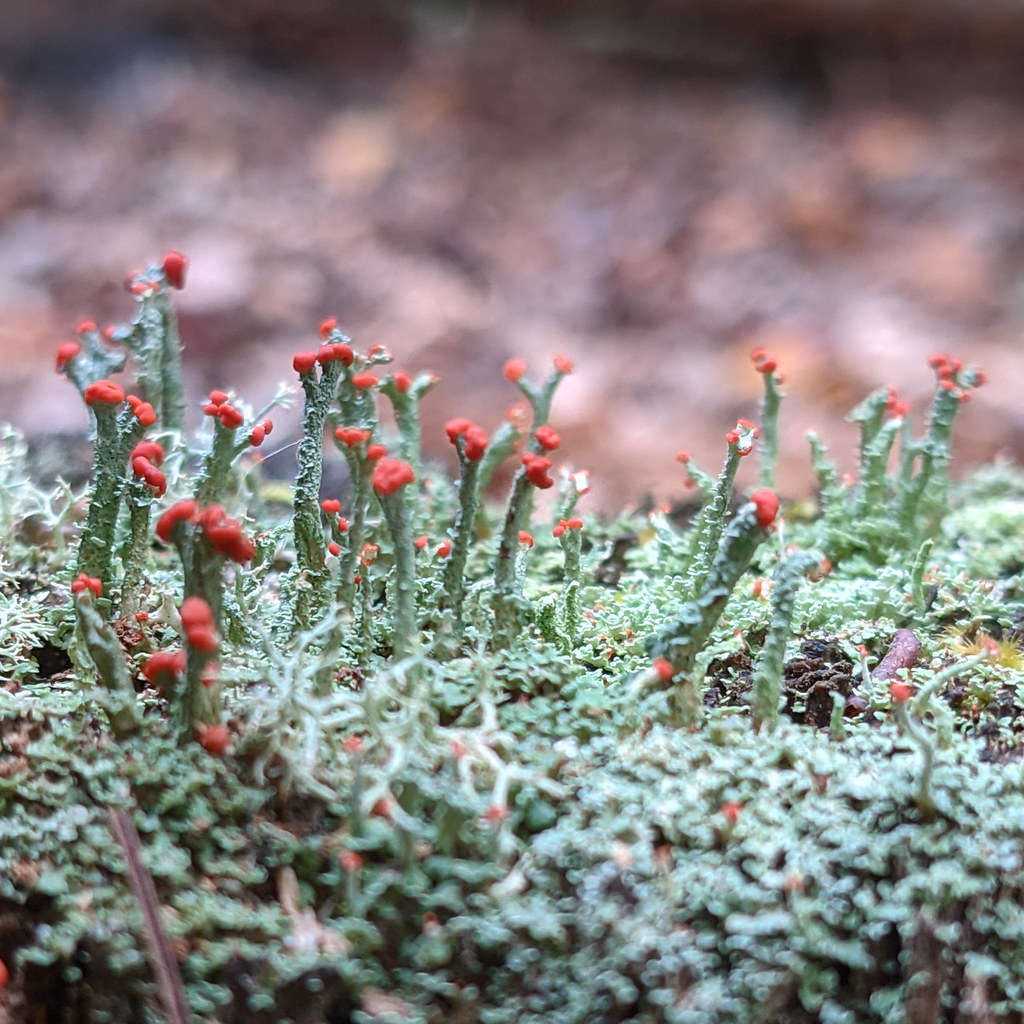
cladonia cristatella
Photo Credits: 20211010 British Soldier Lichen (Cladonia cristatella) maybe (2), schizoform (CC BY 2.0), https://www.flickr.com/photos/84175980@N00/51677798091

A type of lichen that is fairly common in our watershed is Cladonia cristatella, often referred to as British soldier lichen. A lichen is a type of organism that is composed of a symbiotic relationship between a fungus species and an algae species. The presence of certain lichen can be indicators of good air quality as lichens are sensitive to pollutants and changes in their environment. Rather small in size, British soldier lichen grows only to be up to an inch tall and is often found on dead trees or along the base of trees. It is easy to see where British soldier lichen gets its name; the spore-bearing structures called apothecia are bright red, resembling the coats of British soldiers during the American Revolution.

Trametes versicolor
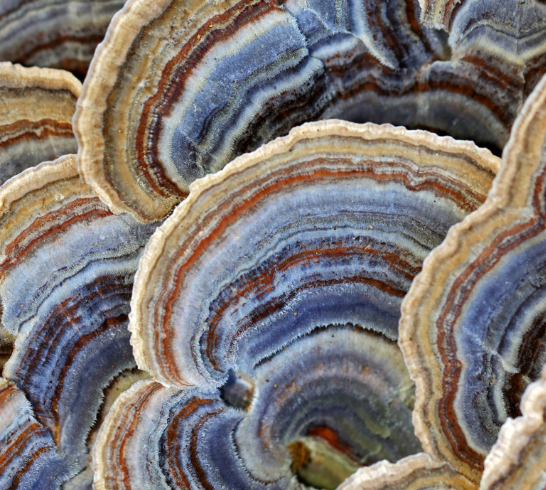
Turkey-Tail (Trametes versicolor) is a type of Bracket Fungi (Family Polyporaceae) and is one of the most common mushrooms found in North America. It can be found on all types of dead deciduous wood, wounded trees, and sometimes conifers, making it an important decomposer of the forest.There are many other similar looking species that are commonly be referred to as “Turkey-Tail”, however true Turkey-Tails have some unique characteristics, which when combined can help to correctly identify them. Similar to British soldier lichen, Turkey-Tail gets its name from its appearance: the colorful cap resembles the feathers of a turkey’s tail. There is record of Trametes versicolor being used as a form of traditional medicine for over 2000 years, and it has more recently been involved in scientific studies for its possible medicinal properties, however, much more research is needed before these properties can be definitively confirmed.  

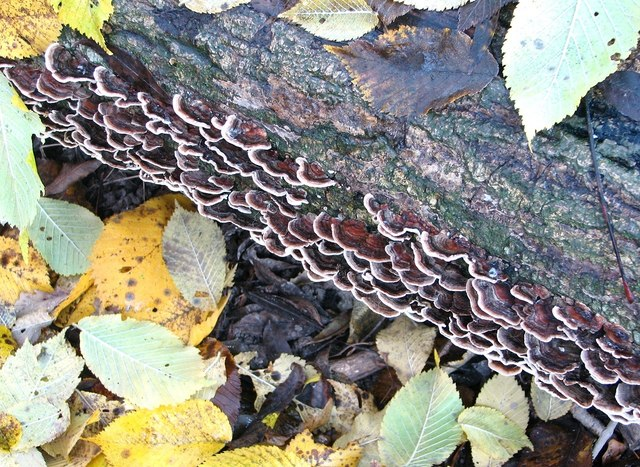
While I was pursuing my Ecology, Evolution, and Natural Resources degree at Rutgers University, Dr. Richard G. Lathrop explained to my class that you can gather insight on how long a tree has been down by quickly examining the Turkey-Tail growing on it. If a tree has been decomposing on the forest floor for a longer period of time, then when it is encountered by a bracket fungi (like Turkey-Tail and its look-alikes), the fungi will grow with its colorful cap laying horizontally, facing the sun (Picture A). On the other hand, if Turkey-Tail begins growing on a dying tree that is still standing during the time of the fungi’s establishment (Picture B), then once the tree falls, the Turkey-Tail will be flipped over to its side, affixed to the tree with the colorful cap no longer facing the sun. Be on the lookout for this next time you’re on a hike – it’s an easy type of ecological investigation that is really neat to notice!

Gymnosporangium juniperi-virginianae

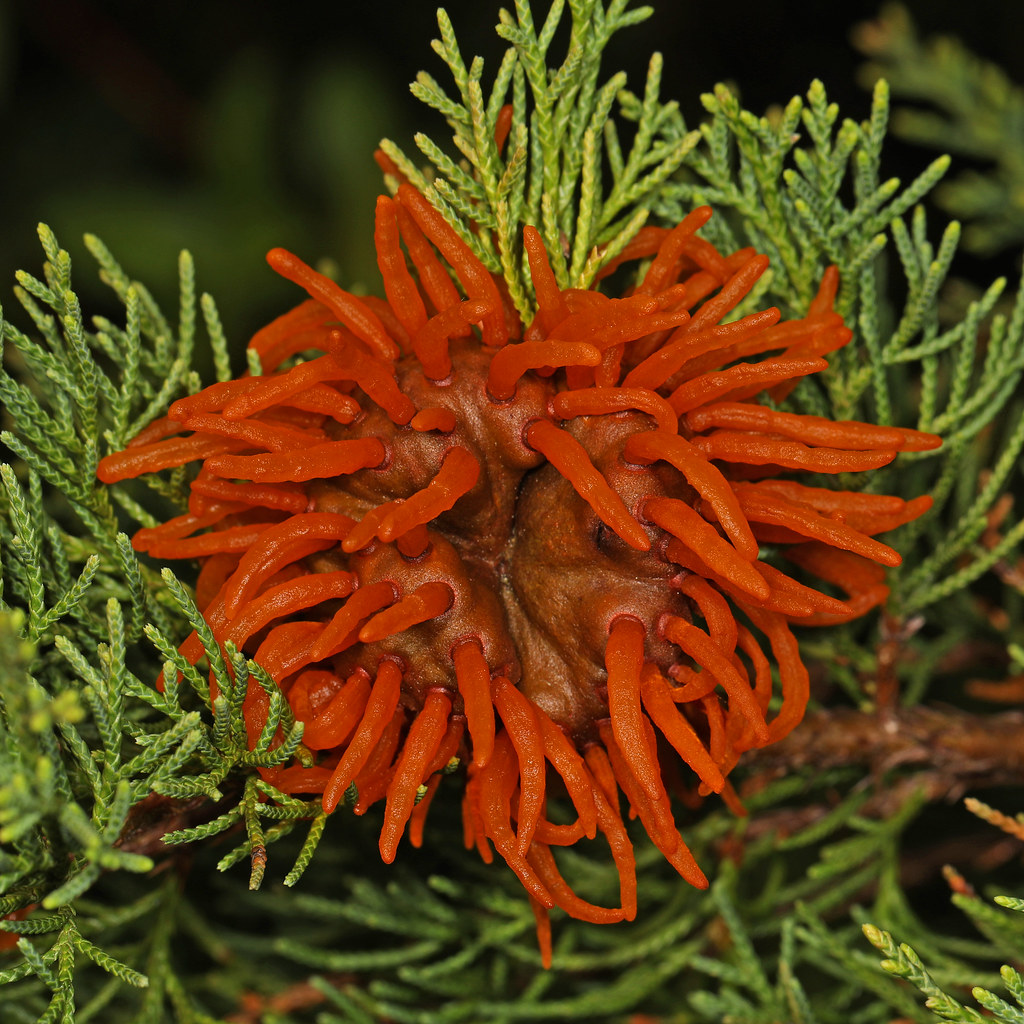
This alien-looking fungi called Cedar Apple Rust (Gymnosporangium juniperi-virginianae) is often found in places where farmland and forest are close to one another. Something intriguing about this fungi (besides its totally bizarre appearance) is that in order to reproduce, it needs two host species: mostly eastern redcedar (Juniperus virginiana) in our region, and crabapple, (Malus or Pyrus spp.), hawthorn (Crataegus spp.) or quince (Cydonia oblonga). Rust fungi are named so because of the rust color they portray during at least one part of their lifecycle. Although sometimes it can lead to negative impacts on apple production and death of redcedar trees when it proliferates, often time it will not do much damage

The left picture shows a Cedar Apple Rust infection on a redcedar (juniper) tree. First, a gall will appear on the tree, next the gall will form spores out of gelatinous masses, then telial horns will form the following spring. After rainfall, these telial horns quickly grow longer and brighter in color. Spores from here can not infect new redcedars, rather at this point in the lifecycle, they will move onto the next new host species. After the spores leave the redcedar, they will travel to nearby apples or crabapples and infect the leaves (as seen in the second picture). Circular yellow markings eventually turn into black spots, and then finally take form in rust-colored spores that are ready to find another redcedar tree and start the lifecycle again. 


There is so much more to learn in the incredibly diverse world of Fungi. There might be as many as 5 million species of fungi worldwide, with most still waiting to be discovered. To appreciate just how astronomical this number is, in comparison, there are about 33,000 species of described fish – and they are the most biodiverse group of vertebrates! Even less than that, there are between only 6,000 – 7,000 species of mammals found worldwide. Their abundance just goes to show how crucial fungi are in our environment, within and outside of the Barnegat Bay watershed. 

Explore More Insights from Barnegat Bay

Dive deeper into the ongoing efforts to protect and restore our environment with more updates and initiatives that you can take part in. Check out our latest blog posts for valuable tips and insights.

UNKNOWN

There is limited data available to quantify Wetland and Riparian Buffer Preservation, or updated data to quantify Wetland Acreage. The BBP has obtained funding and will begin assessment efforts for both targets, in the next few years.


 Hard Clam abundance has not been updated since 2012. Recovery of the stock will be guided by the Fishery Management Plan for Hard Clams, which is under development with the NJDEP, BBP, and other organizations. Reclam the Bay and other partners have continued to plant clams for restoration purposes. Continued plantings in strategic locations which maximize survival and reproduction is one strategy to pursue in the coming years. This work can use a model developed by Rutgers with BBP funding which identified areas where planted clams could have the greatest dispersal of their larvae and thus potentially maximally contribute to the recovery of the stock.

 Water Withdrawals were over the target in the 2021 report; USGS has not yet completed its latest update, so a definitive determination of status is not available. However, additional NJDEP data show that it is likely that we continue to not meet the target. Per capita water use has gone down, demonstrating the effectiveness of water-saving appliances and practices, but that decrease has been offset by population gains. 


IN PROGRESS

New maps quantifying Submerged Aquatic Vegetation extent were developed, but poor image clarity resulted in a high degree of uncertainty in the total acreage. NJDEP and Rutgers are working to resolve the uncertainty of these maps, and improve the total acreage estimate. Funding has also been obtained for further research and restoration activities. Several groups are developing potential restoration actions.

The USGS has completed the first phase of its study to identify minimum ecological flows in select Barnegat Bay tributaries. USGS scientists compared streamflow statistics between historical and current time periods to better understand trends in watershed flow conditions. This work provides a foundation for developing ecological flow targets in the Barnegat Bay watershed.  Similar to SAV extent, funding (approximately $450K) has been obtained by the BBP to complete the remaining phases necessary for threshold determination.


TARGETS ACHIEVED

No targets can be considered “Achieved” at this time.


NOT ACHIEVING

Several Public Swimming Beaches exceeded their safe swimming standards more frequently than during their baseline time period (2016-2018).

While most beaches are routinely safe for swimming, several problematic areas such as Beachwood, Hancock, Windward, and several lake beaches need track-down studies and restoration to pinpoint and address sources of bacteria.

Acres of Approved Shellfish Waters decreased from the last report. While this decrease was small, it represents a loss of previously approved waters. Similar to public beaches, track-down studies and restoration work are needed to pinpoint and address sources of bacteria.


Appreciating our Watershed’s Fungi: Guest Blog by Brianna Casario

This blog was written by BBP’s technician, and former NJ Watershed Ambassador, Brianna Casario.


The Fungi Kingdom can be easily overlooked when one is out exploring the natural world. Although mushrooms might not be thought to be as charismatic as plants or animals, fungi play a crucial role in the ecosystem and without them our intricately connected systems could collapse. The Barnegat Bay Watershed is home to many species of fascinating fungi. 

Here is an overview of some of the most interesting fungi (in my opinion) spotted in or near Ocean County. I found most of these recorded observations through a deep dive into the research grade observations on iNaturalist.

Entoloma indigoferum

Entoloma indigoferum
Photo Credit: Entoloma indigoferum, Garrett Taylor (CC0 1.0), https://www.inaturalist.org/photos/95546161

The Entoloma indigoferum in particular is a mushroom to get excited about. This beautiful gilled mushroom has pink spores and grows in Atlantic White-Cedar swamps, a rather unique ecosystem found in many regions of the Barnegat Bay watershed. The New Jersey Mycological Association lists it as a Rarely Recorded Fungi with only 197 iNaturalist sightings in New Jersey recorded. Of which, 120 of these sightings were located within Ocean County!

Cladonia cristatella

cladonia cristatella
Photo Credits: 20211010 British Soldier Lichen (Cladonia cristatella) maybe (2), schizoform (CC BY 2.0), https://www.flickr.com/photos/84175980@N00/51677798091

A type of lichen that is fairly common in our watershed is Cladonia cristatella, often referred to as British soldier lichen. A lichen is a type of organism that is composed of a symbiotic relationship between a fungus species and an algae species. The presence of certain lichen can be indicators of good air quality as lichens are sensitive to pollutants and changes in their environment. Rather small in size, British soldier lichen grows only to be up to an inch tall and is often found on dead trees or along the base of trees. It is easy to see where British soldier lichen gets its name; the spore-bearing structures called apothecia are bright red, resembling the coats of British soldiers during the American Revolution.

Trametes versicolor
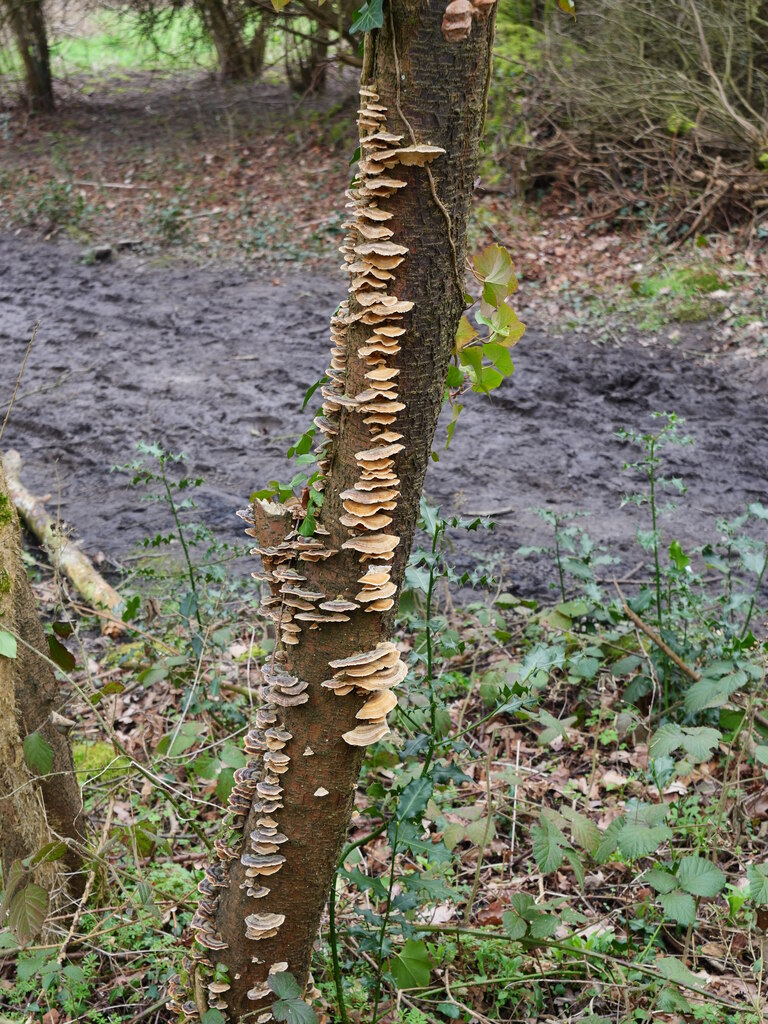
Turkey-Tail (Trametes versicolor) is a type of Bracket Fungi (Family Polyporaceae) and is one of the most common mushrooms found in North America. It can be found on all types of dead deciduous wood, wounded trees, and sometimes conifers, making it an important decomposer of the forest.There are many other similar looking species that are commonly be referred to as “Turkey-Tail”, however true Turkey-Tails have some unique characteristics, which when combined can help to correctly identify them. Similar to British soldier lichen, Turkey-Tail gets its name from its appearance: the colorful cap resembles the feathers of a turkey’s tail. There is record of Trametes versicolor being used as a form of traditional medicine for over 2000 years, and it has more recently been involved in scientific studies for its possible medicinal properties, however, much more research is needed before these properties can be definitively confirmed.  

While I was pursuing my Ecology, Evolution, and Natural Resources degree at Rutgers University, Dr. Richard G. Lathrop explained to my class that you can gather insight on how long a tree has been down by quickly examining the Turkey-Tail growing on it. If a tree has been decomposing on the forest floor for a longer period of time, then when it is encountered by a bracket fungi (like Turkey-Tail and its look-alikes), the fungi will grow with its colorful cap laying horizontally, facing the sun (Picture A). On the other hand, if Turkey-Tail begins growing on a dying tree that is still standing during the time of the fungi’s establishment (Picture B), then once the tree falls, the Turkey-Tail will be flipped over to its side, affixed to the tree with the colorful cap no longer facing the sun. Be on the lookout for this next time you’re on a hike – it’s an easy type of ecological investigation that is really neat to notice!

Gymnosporangium juniperi-virginianae
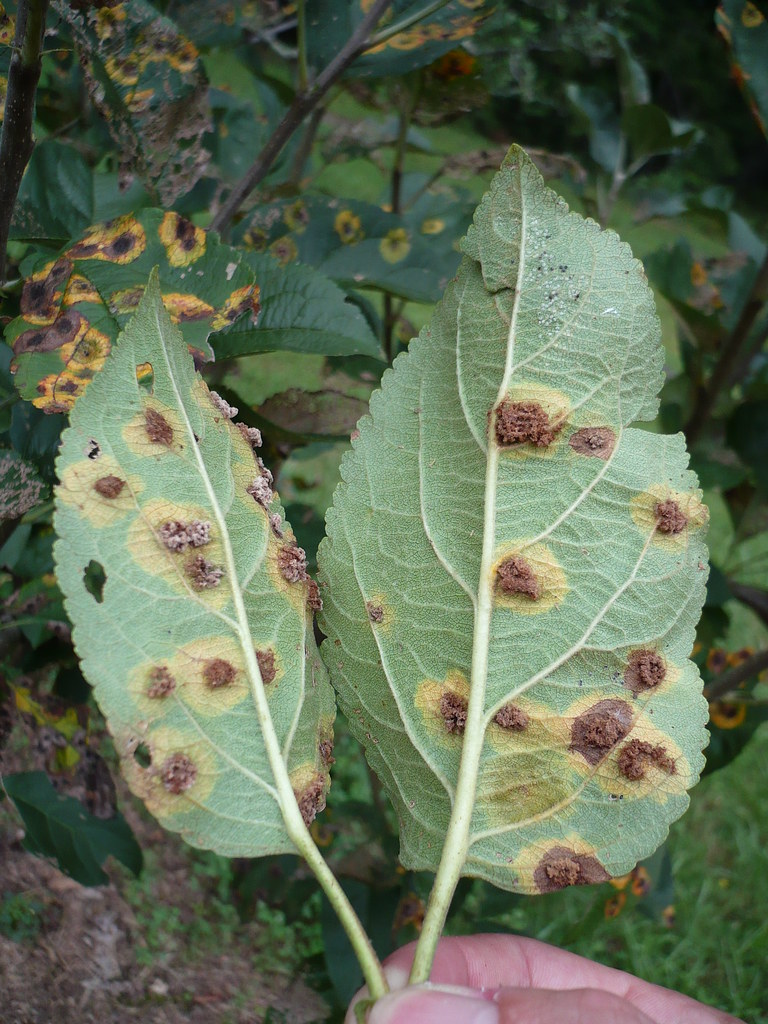
This alien-looking fungi called Cedar Apple Rust (Gymnosporangium juniperi-virginianae) is often found in places where farmland and forest are close to one another. Something intriguing about this fungi (besides its totally bizarre appearance) is that in order to reproduce, it needs two host species: mostly eastern redcedar (Juniperus virginiana) in our region, and crabapple, (Malus or Pyrus spp.), hawthorn (Crataegus spp.) or quince (Cydonia oblonga). Rust fungi are named so because of the rust color they portray during at least one part of their lifecycle. Although sometimes it can lead to negative impacts on apple production and death of redcedar trees when it proliferates, often time it will not do much damage

The left picture shows a Cedar Apple Rust infection on a redcedar (juniper) tree. First, a gall will appear on the tree, next the gall will form spores out of gelatinous masses, then telial horns will form the following spring. After rainfall, these telial horns quickly grow longer and brighter in color. Spores from here can not infect new redcedars, rather at this point in the lifecycle, they will move onto the next new host species. After the spores leave the redcedar, they will travel to nearby apples or crabapples and infect the leaves (as seen in the second picture). Circular yellow markings eventually turn into black spots, and then finally take form in rust-colored spores that are ready to find another redcedar tree and start the lifecycle again. 


There is so much more to learn in the incredibly diverse world of Fungi. There might be as many as 5 million species of fungi worldwide, with most still waiting to be discovered. To appreciate just how astronomical this number is, in comparison, there are about 33,000 species of described fish – and they are the most biodiverse group of vertebrates! Even less than that, there are between only 6,000 – 7,000 species of mammals found worldwide. Their abundance just goes to show how crucial fungi are in our environment, within and outside of the Barnegat Bay watershed. 
Contact Appreciating our Watershed’s Fungi: Guest Blog by Brianna CasarioContact Appreciating our Watershed’s Fungi: Guest Blog by Brianna Casario
Trametes versicolor Turkey-Tail
Photo Credits: 272/366 Turkey-tail - Trametes versicolor, Prince William Forest Park, Triangle, Virginia, Judy Gallagher (CC BY 2.0), https://www.flickr.com/photos/52450054@N04/50395744798